
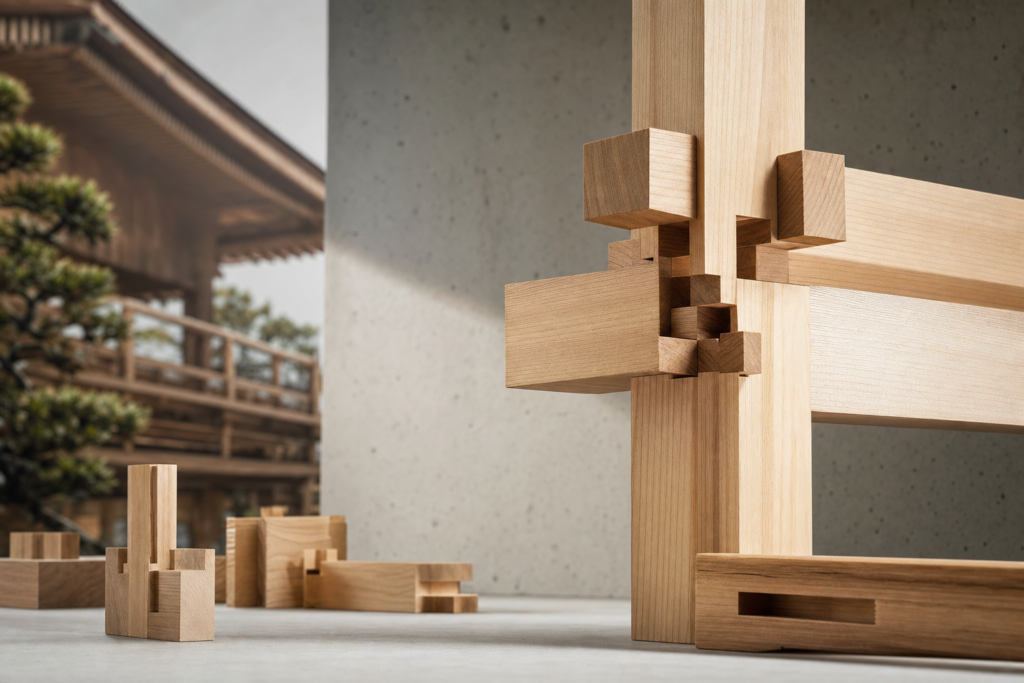
What is Japanese Joinery
Japanese joinery is a centuries-old woodworking tradition renowned for its intricate wood connections crafted without the use of metal fasteners. This technique, deeply embedded in traditional carpentry, emphasizes precision and artistry, resulting in structures that have endured for hundreds of years. From ancient temples to pagodas, Japanese joinery showcases remarkable craftsmanship that balances form and function. Notably, the wooden architecture of Japan is recognized by UNESCO as a living body of traditional skills and knowledge, reflecting a rich cultural heritage of restoration and craft transmission (UNESCO).
Engineering Principles Behind Timber Joints
At the core of Japanese joinery lies a sophisticated understanding of timber joints, particularly the mortise and tenon technique. These joints involve interlocking wood components designed to distribute loads evenly and enhance structural integrity without relying on nails or screws. Mechanical models reveal how features like column rocking and beam rotational resistance contribute to the joints’ strength and flexibility (scholarly review). This engineering logic allows the timber to behave dynamically under stress, offering durability that metal fixings often cannot match in seismic contexts.
Seismic Resilience and Movement
One of the standout advantages of Japanese joinery is its seismic resilience. The joints are designed to allow controlled movement, enabling buildings to absorb and dissipate earthquake energy effectively. A prime example is the Tōji’s five-story pagoda, which employs elaborate timber joints combined with a central column and joint play to withstand seismic shaking without damage (official example). Compared to some modern seismic timber techniques, traditional Japanese methods offer a natural flexibility that reduces structural stress during earthquakes, making them highly relevant for earthquake-prone regions.
Key Joint Types
Japanese joinery features a variety of specialized joints, each crafted for specific structural and aesthetic purposes. Some of the most important types include:
- Dovetail joints: Known for their interlocking wedge shapes, providing strong resistance to pulling forces.
- Scarf joints: Used to join two pieces of timber end-to-end, ensuring continuity and strength.
- Tsugite and Shiguchi: Complex joint classifications that enable intricate wood connections without metal.
These joints exemplify the ingenuity of wood connections in Japanese carpentry and are often illustrated with detailed diagrams to guide craftsmen (joint catalog and modeling). Historically, these joint types have been integral to the construction of temples, shrines, and residential buildings, demonstrating their durability and versatility.
Where Western Builders Can Adapt the Ideas
Western builders can draw valuable lessons from Japanese joinery by integrating its principles into modern carpentry and craft construction. For example, adopting mortise and tenon joints in timber framing can enhance both the aesthetics and structural performance of buildings. Contemporary projects have successfully combined traditional Japanese techniques with digital fabrication and prefabrication methods, creating demountable and seismic-resilient urban timber structures (modern project example). Builders aiming to improve craftsmanship and sustainability should consider these approaches, especially when seeking to reduce dependency on metal fasteners.
Where Metal Fixings Still Make Sense
While Japanese joinery offers many benefits, metal fixings remain practical and sometimes necessary in certain scenarios. For instance, in large-scale or high-load applications, nails, screws, bolts, and metal connectors provide quick assembly and cost-effective reinforcement that traditional joints alone may not achieve (structural role of metal fasteners). A balanced approach involves assessing the project’s demands: if rapid assembly and cost constraints dominate, metal fixings are preferable; if longevity and seismic resilience are priorities, traditional joints shine. Hybrid projects that combine both methods can optimize durability and efficiency.
Modern Revival Examples
There is a growing modern revival of Japanese joinery techniques in contemporary architecture. Projects like the PREWOOD building integrate traditional timber joinery with digital fabrication and seismic-performance requirements to meet urban building standards (PREWOOD project). This revival is motivated by a desire to preserve craftsmanship, improve sustainability, and enhance structural resilience. Architects and developers involved in these projects emphasize the cultural and technical value of blending old and new methods.
Practical Lessons for Contemporary Timber Work
For timber engineers and builders, the key takeaway from Japanese joinery is the importance of precision and flexibility in wood connections. Practical tips include:
- Invest time in mastering mortise and tenon techniques to improve joint performance.
- Consider controlled movement in joint design to enhance seismic resilience.
- Use digital tools and parametric modeling to adapt traditional joints to modern requirements (parametric modeling).
Exploring workshops and expert resources can further deepen understanding and skill in this area.
Is Japanese Joinery Beginner-Friendly?
Japanese joinery may seem daunting to beginners due to its precision and complexity. However, with patience and proper guidance, it is accessible. Many workshops and tutorials cater to newcomers, offering step-by-step instruction on fundamental joints. Beginners who start with simpler mortise and tenon joints often find success and gradually progress to more intricate connections. The key is to avoid rushing; a common pitfall is attempting complex joints without mastering basics, which can lead to frustration and errors.
Explore Further Educational Resources
To continue your journey into Japanese joinery, consider exploring specialized books, online courses, and hands-on workshops. Resources linked to traditional wooden architecture and timber engineering can provide valuable insights. Engaging with expert-produced educational content and guides will help solidify your knowledge and skills. Embracing these educational resources is a practical next step for architects, interior designers, and developers eager to integrate these time-tested techniques into their work.
Japanese joinery offers a fascinating blend of artistry, engineering, and resilience that Western builders can learn from and adapt. By exploring these techniques further, you can elevate your craft and contribute to more sustainable and durable timber construction.
