
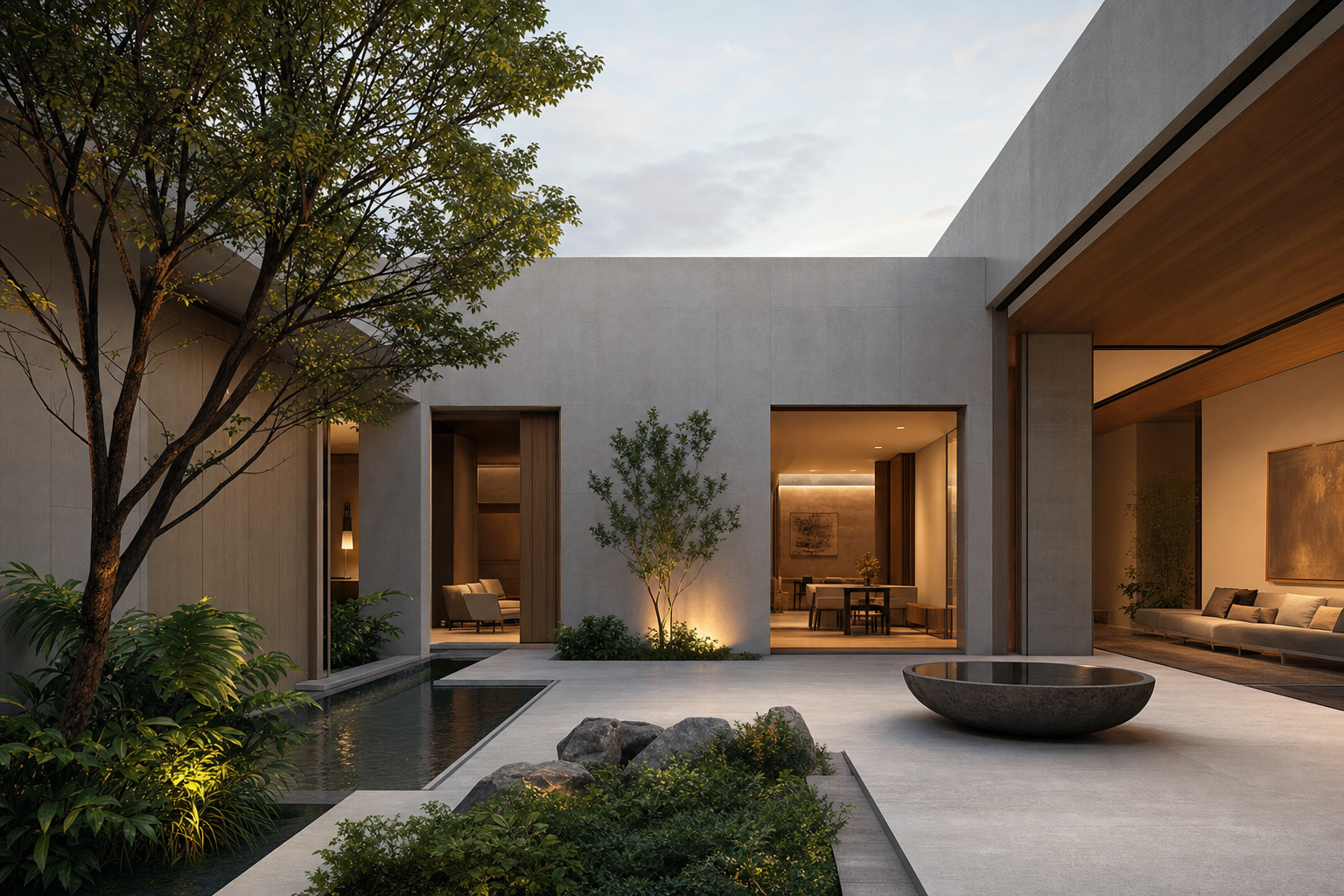
Define Courtyard House Design
A courtyard house is a residential building organized around a central open space, or courtyard, which serves as a private outdoor area enclosed by the building’s walls. This design typology has deep historical roots and cultural significance across many regions, including Iran, China, and the Mediterranean, where it evolved to meet social, climatic, and spatial needs.
Historically, courtyard houses provided privacy and security, with the courtyard acting as a protected outdoor living area. For example, the traditional Yazd courtyard houses in Iran illustrate how spatial organization around a courtyard addressed privacy and safety, while adapting to harsh desert climates.
Modern courtyard house designs reinterpret these principles for urban contexts, integrating contemporary materials and technologies while maintaining the core benefits of privacy and natural light. Unlike typical homes with external facades exposed to the street, courtyard houses focus inward, creating a serene microenvironment protected from urban noise and views.
A common misconception is that courtyard houses require large plots. However, as demonstrated by Jean-François Zevaco’s interlocked patio designs in Agadir, Morocco, courtyard houses can be adapted effectively to compact urban sites, providing light and ventilation from multiple directions [source].
Why Courtyards Solve Privacy and Light
Internal courtyards excel at creating private outdoor spaces shielded from neighbors and street views. This inward focus allows residents to enjoy daylight and fresh air without sacrificing privacy.
Courtyards maximize natural light penetration into surrounding rooms by acting as light wells, often more effectively than traditional window placements on external facades. The courtyard’s open sky exposure enables daylight to reach deeper into the home’s interior.
Compared to other architectural solutions like street-facing windows with blinds or fences, courtyard designs offer a more integrated and permanent privacy solution that enhances the quality of indoor lighting. Urban courtyard homes often demonstrate this balance, where the courtyard acts as a sanctuary providing daylight without exposure.
Architects emphasize that the courtyard’s enclosure and orientation are key to optimizing privacy and daylight simultaneously, a balance harder to achieve with conventional layouts.
Ventilation and Cooling Logic
Courtyard houses naturally harness passive cooling strategies, especially in warm climates. The courtyard facilitates cross ventilation by allowing air to flow through multiple openings, cooling indoor spaces without mechanical systems.
According to a government-backed overview of natural ventilation and cooling, the chimney effect and cross ventilation are essential principles utilized in courtyard designs. Air enters through lower openings, rises as it warms, and exits through higher openings or the open courtyard, creating continuous airflow.
In hot climate architecture, courtyards reduce overheating by shading walls and creating cooler microclimates with vegetation and water features. These elements enhance evaporative cooling and reduce solar heat gain.
For example, in regions with hot summers, if the courtyard is oriented to minimize direct afternoon sun and includes shading devices, the passive cooling effect is maximized; if not, the courtyard may inadvertently increase solar heat gain, leading to overheating risks.
Courtyard Proportions and Orientation
Optimal courtyard proportions and orientation are critical to ensure effective daylight, ventilation, and thermal comfort. Research shows that the courtyard’s size relative to the building footprint influences air movement and solar exposure.
For small urban plots, a courtyard occupying approximately 20–30% of the total site can balance indoor space with outdoor openness. Orientation towards prevailing winds supports cross ventilation, while positioning the courtyard to the south (in the northern hemisphere) maximizes winter sun and minimizes summer overheating.
Designers should carefully consider courtyard geometry, openings, shading, and vegetation to enhance microclimate and energy efficiency, as detailed in a comprehensive review of courtyard design principles.
A common pitfall is neglecting to align the courtyard with local climate patterns, which can reduce ventilation effectiveness and increase energy use. To avoid this, always analyze site-specific wind and solar data during design.
Compact Urban Sites
Courtyard houses adapt well to compact urban sites by creatively organizing indoor and outdoor spaces. Interlocking courtyards and patios can provide multiple private outdoor areas without requiring expansive land.
Urban zoning and space utilization strategies, such as multi-level courtyards or roof terraces, help maximize the benefits of indoor-outdoor living within limited footprints.
Jean-François Zevaco’s courtyard houses in Agadir demonstrate how interlocked patios provide privacy, access to daylight, and cross ventilation from two directions, even on constrained urban sites [source].
Developers increasingly recognize these benefits, as courtyard designs enhance occupant wellbeing and property value by integrating nature and fresh air into dense environments.
Global Courtyard House Examples
Courtyard houses span diverse cultures and climates, each adapting the concept with unique materials and spatial configurations.
In Iran, the Yazd courtyard houses use thick adobe walls and wind catchers to maintain comfort in desert conditions. In Morocco, Zevaco’s modern courtyard houses blend traditional patios with contemporary forms to suit urban settings [source].
Asian courtyard homes often incorporate gardens and water features to create tranquil environments, while Mediterranean designs emphasize shaded loggias and terraces.
These global examples highlight how courtyard house design principles are flexible and scalable, supporting indoor-outdoor living, privacy, and passive environmental control across contexts.
Risks Around Drainage and Overheating
Despite their benefits, courtyard houses face challenges related to drainage and overheating if not carefully designed.
Water can accumulate in courtyards if proper drainage is not installed, leading to structural damage or mold. Building codes require secondary emergency drains or scuppers to manage overflow where primary drainage might fail [source].
Overheating is another risk, especially if the courtyard is too small or oriented to receive intense solar radiation without shading. Studies show that courtyard proportions and orientation strongly influence thermal performance, with poor design increasing solar heat gain and discomfort [source].
Mitigation strategies include incorporating shading devices, vegetation, water features, and reflective materials, as well as designing for adequate air flow to dissipate heat.
Design Checklist for Courtyard Homes
- Determine optimal courtyard size relative to plot and building footprint (aim for 20–30% in compact sites).
- Orient courtyard to maximize prevailing winds for cross ventilation and solar exposure for seasonal comfort.
- Incorporate shading elements such as pergolas, trees, or screens to reduce overheating.
- Design openings and fenestration to facilitate natural ventilation and daylight penetration.
- Include vegetation and water features for microclimate enhancement and passive cooling.
- Ensure proper drainage systems with secondary emergency drains to prevent water accumulation.
- Balance indoor-outdoor transitions for privacy and usability.
- Use materials with appropriate thermal mass and reflectivity based on climate.
- Consult local building codes and climate data during design.
- Review successful courtyard projects for inspiration and validation.
Next Steps in Courtyard House Design
To deepen your understanding of courtyard house design, explore detailed case studies and architectural analyses from diverse regions. Engage with professional development opportunities focused on sustainable and climate-responsive architecture.
Consider consulting with experts who specialize in courtyard design to tailor solutions for your specific projects and contexts.
Embracing courtyard house principles can elevate your designs, enhancing privacy, comfort, and environmental performance in modern living spaces.