
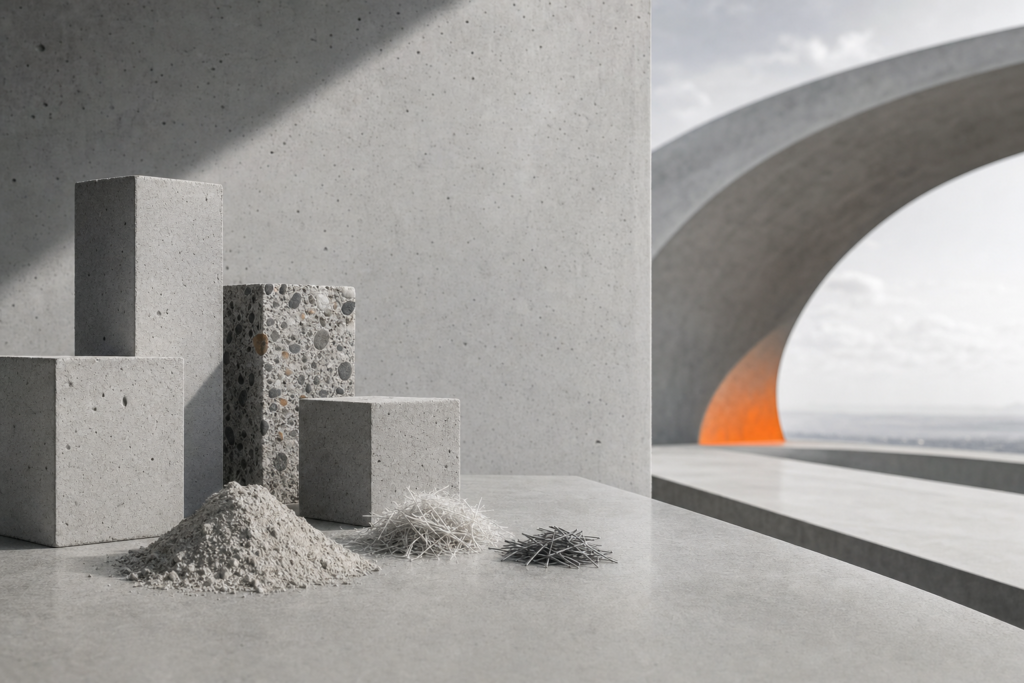
Define Ultra-High-Performance Concrete and Its Composition
Ultra-High-Performance Concrete (UHPC) represents a cutting-edge advancement in concrete technology, distinguished by its exceptional strength and durability. Unlike traditional concrete, UHPC incorporates a refined mix design comprising fine aggregates, portland cement, supplementary cementitious materials (SCMs), high-range water-reducing admixtures (HRWRAs), and fibers. This composition results in a dense, low-permeability material that exhibits superior mechanical properties. For example, typical UHPC mixes exclude coarse aggregates, favoring fine sands to enhance homogeneity and performance, setting it apart from conventional concrete mixes which rely heavily on gravel or crushed stone for strength and volume.ACI’s UHPC TechNote provides detailed insights into these constituents and their roles.
How UHPC Differs from Conventional and High-Performance Concrete
While high-performance concrete (HPC) has pushed the boundaries of strength and durability beyond conventional concrete, UHPC elevates these attributes further through its unique formulation and fiber reinforcement. UHPC typically achieves compressive strengths exceeding 150 MPa, markedly higher than HPC’s usual range of 50 to 100 MPa. Moreover, UHPC’s post-cracking tensile resistance due to fiber inclusion offers enhanced ductility and toughness, which is not common in conventional or even HPC mixes. These properties make UHPC suitable for applications demanding extraordinary structural performance and longevity. The FHWA state-of-the-art report documents various projects illustrating these differences and the resulting benefits in bridge and infrastructure applications.
Compressive Strength, Tensile Behaviour, and Durability
UHPC’s hallmark is its remarkable compressive strength, often ranging from 120 to 220 MPa, far surpassing conventional concrete’s typical 20 to 40 MPa. This strength is complemented by enhanced tensile behavior, primarily due to the fiber reinforcement, which imparts post-cracking load-bearing capacity and reduces brittleness. Durability is another critical advantage; UHPC’s dense matrix and discontinuous pore structure significantly impede water and chloride ingress, thereby resisting freeze-thaw cycles, chemical attack, and abrasion. Such resilience extends the lifespan of structures, especially in harsh environments. The FHWA UHPC TechNote offers comprehensive data on these mechanical and durability properties, demonstrating UHPC’s superiority in demanding conditions.
Role of Fibres, Mix Design, and Curing
Fibres are integral to UHPC, providing tensile strength and ductility that traditional concrete lacks. Common fibers include steel, synthetic, and sometimes hybrid combinations, each contributing to crack control and energy absorption. The mix design is meticulously engineered to achieve a dense, homogeneous matrix, balancing cementitious materials, fine aggregates, and admixtures for optimal workability and performance. Curing practices are equally crucial; UHPC often requires controlled curing regimes, such as steam curing or extended moist curing, to develop its full strength and durability potential. Variations in mix design and fiber type can tailor UHPC for specific applications, as discussed in the ACI TechNote and supported by case studies in the FHWA report.
Architectural Applications in Façades, Bridges, and Structural Components
UHPC’s combination of strength, durability, and aesthetic versatility opens exciting possibilities in architecture. Façade panels made from UHPC can be thin, lightweight, and intricately textured or curved, enabling innovative designs that would be impractical with conventional concrete. For example, the Atrium project profile showcases UHPC façade panels used in a unitized curtainwall system, demonstrating both functional and visual benefits. In bridge construction, UHPC allows for slender structural components with extended service lives, reducing maintenance and enhancing safety. Structural elements benefit from UHPC’s reduced reinforcement congestion and improved durability, making it an attractive choice for long-span and high-load applications.
Potential for Thinner Elements and Complex Geometry
One of UHPC’s most significant architectural advantages is enabling slender, complex geometries that challenge traditional concrete limitations. Its high strength-to-weight ratio allows designers to create thin shells, delicate curves, and intricate forms without compromising structural integrity. This capability not only expands aesthetic freedom but also reduces material usage and foundation loads. Projects featuring thin UHPC elements demonstrate how designers can achieve elegant, lightweight structures that are both durable and visually striking, unlocking new paradigms in concrete architecture.
UHPC vs Conventional Concrete Performance Comparison
A direct comparison highlights UHPC’s superior performance metrics over conventional concrete. UHPC typically exhibits compressive strengths 3 to 5 times greater, enhanced tensile capacity owing to fiber reinforcement, and significantly improved durability due to its dense microstructure. However, UHPC’s higher material and processing costs and specialized fabrication requirements contrast with conventional concrete’s accessibility and cost-effectiveness. Such trade-offs mean that while UHPC excels in performance, it is not universally the best choice. The FHWA TechNote provides detailed charts and data illustrating these performance distinctions.
Fabrication, Connection, and Specification Challenges
Despite its advantages, UHPC presents practical challenges. Fabrication requires precise control over mixing, placing, and curing to achieve consistent quality. Connections between UHPC elements and other materials can be complex due to differing stiffness and thermal expansion properties. Additionally, specifying UHPC demands careful consideration of mix design, structural detailing, and construction sequencing to avoid pitfalls such as inadequate curing or reinforcement congestion. A common pitfall is underestimating the need for specialized labor and equipment, which can lead to defects or cost overruns. The FHWA workshop manual offers practical guidance on overcoming these challenges in design and construction workflows.
Cost and Availability Considerations
Cost remains a significant factor in UHPC adoption. Material costs are higher than traditional concrete due to premium constituents like fine powders and fibers, as well as energy-intensive processing. Availability varies regionally, with some markets having limited suppliers or experience with UHPC. When evaluating cost, it is essential to consider lifecycle savings from reduced maintenance and longer service life, which can offset initial expenses. Cost comparison tables in the FHWA report help contextualize these factors for informed decision-making.
Embodied Carbon and Lifecycle Trade-offs
UHPC’s environmental impact is nuanced. While its high cement and energy content contribute to a larger embodied carbon footprint compared to conventional concrete, its extended durability and potential for reduced material volume can result in favorable lifecycle assessments. Strategies to lower UHPC’s carbon footprint include incorporating supplementary cementitious materials and optimizing mix designs. The Nature review provides a comprehensive analysis of these trade-offs, highlighting the importance of considering full lifecycle impacts rather than upfront emissions alone.
When Specifying UHPC is Justified
Deciding to specify UHPC should be based on project-specific criteria. Use UHPC when:
- Structural demands exceed conventional concrete capabilities, such as high compressive strength or tensile requirements.
- Durability is critical, especially in aggressive environments requiring long service life with minimal maintenance.
- Architectural goals include slender, complex, or textured elements that traditional concrete cannot achieve efficiently.
If these conditions are not met, conventional or high-performance concrete may provide more cost-effective solutions. A practical decision rule is: if the project requires exceptional strength, durability, or design freedom that justifies higher costs and fabrication complexity, specify UHPC; otherwise, opt for conventional alternatives. The FHWA workshop manual offers frameworks to guide these decisions.
A common pitfall is over-specifying UHPC for applications where its benefits do not outweigh costs and challenges. Avoid this by thorough evaluation of project requirements and consultation with material experts.
Next Steps for Architects and Engineers
For those considering UHPC, engaging with detailed resources and experts is essential. Explore technical notes and case studies from authoritative sources like the ACI TechNote and FHWA reports. Collaborate with UHPC material suppliers and experienced contractors early in the design process to tailor mix designs and fabrication methods to project needs. By doing so, architects and engineers can harness UHPC’s unique properties to push the boundaries of design while managing practical challenges effectively.
