
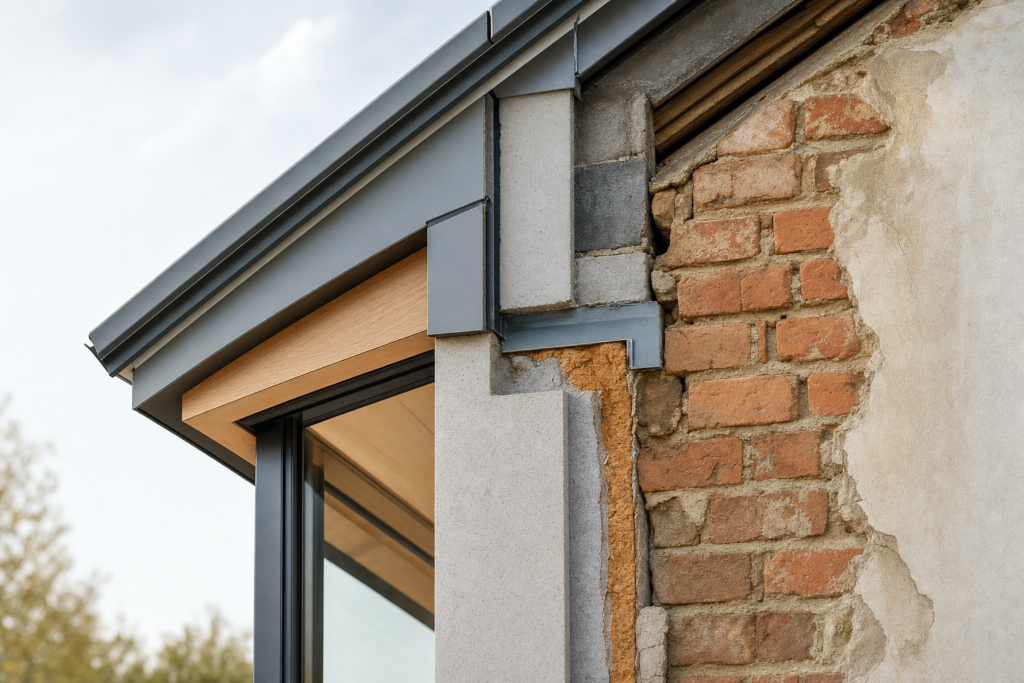
Define Renovation Junction Details
In architectural terms, a renovation junction refers to the critical points where different building elements meet, especially where old structures intersect with new additions or modifications. These junctions include roof-to-wall intersections, floor-to-wall connections, and interfaces between different materials or construction phases.
These junctions are vital in renovation projects because they are often the weakest points susceptible to structural failures, moisture ingress, thermal inefficiencies, and material incompatibility. Proper detailing at these junctions ensures the building’s longevity, energy efficiency, and occupant comfort by preventing common issues such as damp bridging, condensation, and movement-related damage.
Why Junctions Fail
Junction failures typically stem from poor planning, inadequate execution, or a lack of understanding of how old and new building elements interact. When renovation junction details are overlooked or improperly designed, the risk of leaks, thermal bridging, and structural stresses increases significantly.
A frequent pitfall is ignoring the unique challenges that arise when “old meets new“. For example, retrofitting insulation without addressing existing moisture paths can lead to condensation and mold, undermining both the renovation’s success and the building’s health.
If renovation junction details are not carefully planned and executed, the consequences can include costly repairs, reduced energy efficiency, and compromised structural integrity.
Roof-to-Wall and Floor-to-Wall Risks
Roof-to-wall and floor-to-wall junctions present unique challenges because they must accommodate structural loads, prevent water ingress, and maintain thermal continuity. These junctions are particularly vulnerable to leaks, as water can easily penetrate where roofing materials meet vertical walls.
For instance, improper flashing or lack of a continuous air barrier can cause water to seep into the building envelope, leading to dampness and rot. The use of kick-out flashing and step flashing is a proven method to direct water away from these junctions effectively.
A good practice is to ensure that all roof-to-wall junctions have properly installed flashing systems and continuous air and moisture barriers that can flex with building movement. In contrast, poor practices often neglect these details, resulting in visible staining, mold growth, and structural deterioration.
Damp and Moisture Bridging
Damp bridging occurs when moisture bypasses the building’s damp-proof course or membrane, often at junctions where different materials or construction phases meet. This can happen if the renovation junction details fail to maintain a continuous barrier against moisture.
The impact of damp bridging is severe, potentially causing decay of timber elements, corrosion of metal fixings, and degradation of insulation effectiveness. The official guidance on moisture resistance emphasizes the importance of proper damp-proofing and ventilation provisions in floors, walls, and roofs to prevent such issues.
Preventive measures include careful detailing of damp-proof membranes at junctions, ensuring overlaps and seals are continuous, and providing adequate ventilation to allow any trapped moisture to dissipate.
Thermal Bridges and Condensation
Thermal bridging occurs when a junction allows heat to bypass insulation, creating cold spots that can lead to condensation inside the building envelope. This not only wastes energy but also increases the risk of mold growth and material degradation.
Understanding and mitigating thermal bridging is essential for energy-efficient renovations. The Conservation of Fuel and Power guidance stresses the need for continuous insulation and meticulous junction detailing to limit heat loss.
Strategies to minimize thermal bridges include using insulated cavity closers, thermally broken connectors, and ensuring insulation continuity at roof-to-wall and floor-to-wall junctions. For example, if insulation is interrupted at a junction, heat will escape, so it is crucial to design junctions that maintain unbroken insulation layers.
Movement and Material Compatibility
Buildings naturally move due to thermal expansion, moisture changes, and structural loads. Renovation junctions must accommodate this movement to prevent cracking and failure.
Movement joints are essential components that allow different building parts to expand or contract independently. According to government preservation guidelines, selecting appropriate sealants and designing joints that handle active differential movement between materials is critical for long-term durability.
Material compatibility also plays a significant role. For instance, combining materials with vastly different thermal expansion rates without proper joints can cause stress and damage. A useful decision rule is: if materials have incompatible movement characteristics, introduce a flexible movement joint; if not, a rigid connection may suffice.
Examples of Good and Poor Junctions
Comparing successful and unsuccessful junctions helps illustrate the impact of proper detailing.
A well-executed roof-to-wall junction might feature continuous flashing, a sealed air barrier, and insulated cavity closers, resulting in no visible leaks or thermal inefficiencies. Conversely, a poor junction may lack proper flashing and have gaps in the air barrier, leading to water ingress and heat loss.
Visual examples often show that good extension detailing and retrofit junctions prioritize continuity of barriers and accommodate movement, while poor examples neglect these principles, causing premature failures.
Inspection Checklist Before Work Starts
Before beginning renovation work, a thorough inspection of all junctions is crucial. Key points to verify include:
- Continuity of damp-proof membranes and air barriers across junctions.
- Proper installation of flashing at roof-to-wall intersections.
- Presence and condition of movement joints where different materials meet.
- Integrity and compatibility of sealants in masonry and expansion joints.
- Evidence of previous moisture intrusion or thermal bridging issues.
Tools like moisture meters, thermal imaging cameras, and visual inspection are recommended. The WBDG resource on air barrier systems highlights that connections must remain continuous and flexible enough to withstand movement, which should be a focus during inspections.
Industry professionals advise documenting findings and addressing any deficiencies before work commences to avoid costly rework.
Taking the time to conduct a detailed inspection can save significant time and expense, ensuring that renovation junction details are correctly addressed from the outset.
For those interested, a comprehensive inspection checklist download is available to guide your pre-renovation assessments.
By understanding and applying these principles, interior designers, architects, and developers can significantly improve renovation outcomes, ensuring that where old meets new, the junctions stand strong and efficient.
