What is Self-Healing Concrete
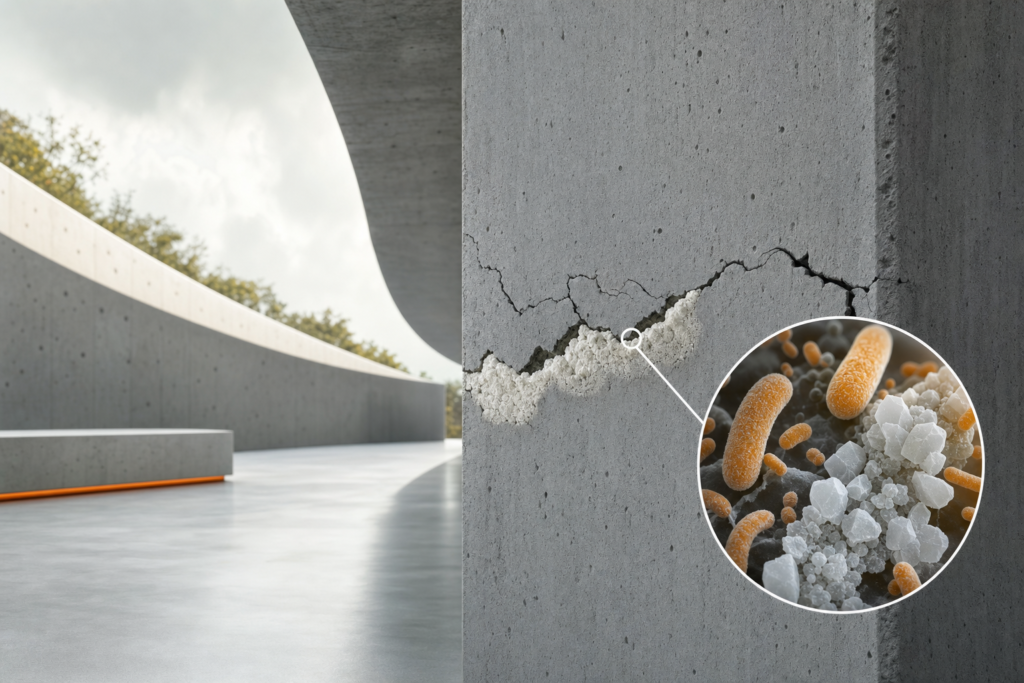
Self-healing concrete represents a groundbreaking innovation in construction materials, designed to autonomously repair its own cracks. At its core, this concrete incorporates specialized bacteria within the mix, often referred to as bacteria concrete or microbial concrete. These bacteria remain dormant until activated by environmental triggers, such as water ingress, initiating a healing process that enhances the material’s longevity and durability.
This technology stands out as a significant advancement in the construction industry, offering a proactive approach to maintaining structural integrity without the need for frequent manual repairs.
How Bacterial Healing Works
The healing mechanism in self-healing concrete revolves around bacteria-induced limestone precipitation. When new cracks form and water penetrates these fissures, it activates the embedded bacteria. These microbes convert calcium lactate into calcium carbonate—a process scientifically known as microbially induced calcium carbonate precipitation. The calcium carbonate then fills and seals the cracks, effectively restoring the concrete’s integrity.
Peer-reviewed studies have demonstrated that bacteria-based concrete specimens with cracks ranging from approximately 0.32 to 0.56 mm can be almost completely healed within 28 days, showcasing the efficiency of this natural repair mechanism.
What Cracks It Can and Cannot Repair
While self-healing concrete excels at repairing small to medium-sized cracks, it does have limitations. Typically, cracks up to around 0.5 mm in width are effectively sealed by the bacterial limestone precipitation process. Larger or deeper cracks may exceed the bacteria’s healing capacity, requiring additional intervention.
For example, in bridge decks, where crack width can vary widely, the healing ability diminishes as cracks widen beyond a certain threshold. A practical decision rule for designers is: if concrete cracks are expected to remain under 0.5 mm, incorporating self-healing concrete can significantly reduce maintenance needs; if larger cracks are anticipated, supplementary repair strategies should be planned.
A common pitfall is overestimating the healing capacity of the bacteria, leading to insufficient repair in cases of significant structural damage. To avoid this, accurate crack width assessment and monitoring are essential when specifying self-healing concrete.
Lab-to-Field Development
Self-healing concrete has evolved through rigorous research phases, transitioning from laboratory innovation to real-world applications. Early studies focused on understanding bacterial survival and limestone production within concrete matrices. Subsequent breakthroughs included scaling up production and testing in realistic environments.
A notable example is the UK Materials for Life full-scale site trial on the A465 highway project, where bacteria-infused self-healing concrete panels were installed. This project provided valuable insights into practical challenges and successful scale-up techniques, marking a key milestone in the technology’s development.
European initiatives like the HEALCON project have further propelled this transition by validating large-scale applications and conducting life-cycle cost analyses focused on road, tunnel, and bridge infrastructure repair. These efforts underline the growing confidence in self-healing concrete’s durability and cost-effectiveness.
Infrastructure Use Cases
Self-healing concrete is increasingly being adopted in various infrastructure projects, particularly where durability and maintenance reduction are critical. Bridge decks serve as a prime example, where the material’s ability to autonomously heal concrete cracks helps extend service life and reduce costly repairs.
Transportation research has documented the benefits of self-healing concrete in bridge deck applications, highlighting improved resistance to cracking and enhanced overall infrastructure repair outcomes. Other uses include tunnels and road surfaces, where exposure to harsh environmental conditions demands materials with superior durability.
These real-world applications demonstrate how self-healing concrete can contribute to more sustainable and resilient infrastructure systems.
Cost and Durability Implications
When considering self-healing concrete, it’s important to weigh upfront costs against long-term benefits. Initial expenses are generally 10–30% higher than traditional concrete due to specialized materials and production processes. However, studies indicate that the reduction in maintenance frequency and extended service life can offset these initial investments.
Durability studies confirm that self-healing concrete can significantly delay the onset of structural deterioration, leading to lower life-cycle costs. For developers and architects, this means that while the initial budget may increase, the overall project value improves through enhanced concrete maintenance and reduced repair disruptions.
Limitations and Adoption Barriers
Despite its promise, self-healing concrete faces several adoption barriers. Technical challenges include ensuring uniform bacteria distribution and viability within the concrete mix. Environmental factors, such as temperature and moisture availability, can also influence healing effectiveness.
Additionally, the need for specialized expertise during design and construction can limit widespread use. The lack of standardized guidelines and certifications further complicates adoption, making some stakeholders hesitant to embrace the technology fully.
Future Outlook
The future outlook for self-healing concrete is optimistic, with ongoing research aimed at enhancing bacterial efficiency, expanding healing capabilities to larger cracks, and integrating the technology into a wider range of applications. Innovations may include genetically engineered bacteria for faster or more robust healing and hybrid materials combining multiple healing mechanisms.
Broader adoption across commercial, residential, and public infrastructure sectors is anticipated as costs decrease and standards evolve. This innovation aligns with the construction industry’s growing focus on sustainability and resilience.
What are the Downsides to Using Self-Healing Concrete?
While self-healing concrete offers many benefits, it also comes with downsides. The initial cost increase of 10–30% compared to conventional concrete can be a significant barrier for some projects. Moreover, the lack of standardized testing and certification means that quality assurance may vary between suppliers.
Another disadvantage is the requirement for specialized knowledge during mixing and placement to ensure bacteria viability and effective healing. These factors can increase complexity and risk during construction.
Explore Further Projects
For those interested in diving deeper into self-healing concrete applications, exploring projects like the A465 highway trial and the HEALCON initiative provides valuable insights. These case studies offer practical examples of successful implementation and lessons learned.
Engaging with expert interviews and educational resources on microbial concrete can further enhance understanding and inspire innovative uses in your own projects.
Self-healing concrete is transforming how we think about maintenance and durability in construction. By exploring current projects and ongoing research, interior designers, architects, and developers can stay at the forefront of this exciting innovation and contribute to more sustainable building practices.
